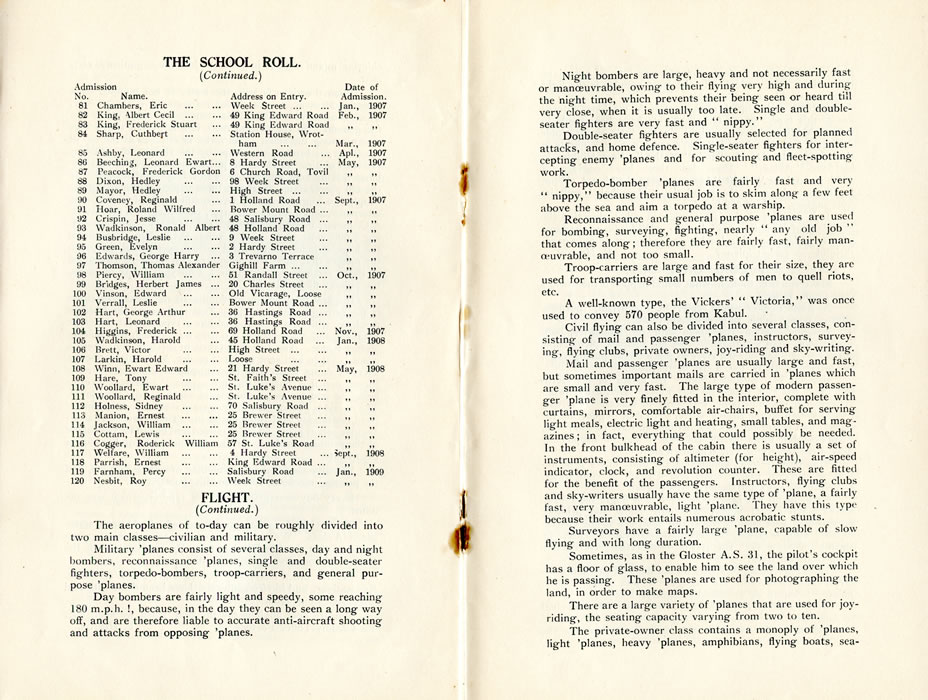
THE SCHOOL ROLL.
(Continued.)
Admission No., Name. Address on Entry. Date of Admission.
81, Chambers, Eric, Week Street, Jan.,1907
82, King, Albert Cecil, 49 King Edward Road, Feb., 1907
83, King, Frederick Stuart, 49 King Edward Road, Feb., 1907
84, Shaip, Cuthbert, Station House, Wrotham, Mar., 1907
85, Ashby, Leonard, Western Road, Apl., 1907
86, Beeching, Leonard Ewart, 8 Hardy Street, May, 1907
87, Peacock, Frederick Gordon, 6 Church Road, Tovil, May, 1907
88, Dixon, Hedley, 98 Week Street, May, 1907
89, Mayor, Hedley, High Street, May, 1907
90, Coveney, Reginald, 1 Holland Road, Sept., 1907
91, Hoar, Roland Wilfred, Bower Mount Road, Sept., 1907
92, Crispin, Jesse, 48 Salisbury Road, Sept., 1907
93, Wadkinson, Ronald Albert, 48 Holland Road, Sept., 1907
94, Busbridge, Leslie, 9 Week Street, Sept., 1907
95, Green, Evelyn, 2 Hardy Street, Sept., 1907
96, Edwards, George Harry, 3 Trevarno Terrace, Sept., 1907
97, Thomson, Thomas Alexander, Gighill Farm, Sept., 1907
98, Piercy, William, 51 Randall Street, Oct., 1907
99, Bridges, Herbert James, 20 Charles Street, Oct., 1907
100, Vinson, Edward, Old Vicarage, Loose, Oct., 1907
101, Verrall, Leslie, Bower Mount Road, Oct., 1907
102, Hart, George Arthur, 36 Hastings Road, Oct., 1907
103, Hart, Leonard, 36 Hastings Road, Oct., 1907
104, Higgins, Frederick, 69 Holland Road, Nov., 1907
105, Wadkinson, Harold, 45 Holland Road, Jan., 1908
106, Brett, Victor, High Street, Jan., 1908
107, Larkin, Harold, Loose, Jan., 1908
108, Winn, Ewart Edward, 21 Hardy Street, May 1908
109, Hare, Tony, St. Faith's Street, May 1908
110, Woollard, Ewart, St. Luke's Avenue, May 1908
111, Woollard, Reginald, St. Luke's Avenue, May 1908
112, Holness, Sidney, 70 Salisbury Road, May 1908
113, Manion, Ernest, 25 Brewer Street, May 1908
114, Jackson, William, 25 Brewer Street, May 1908
115, Cottam, Lewis, 25 Brewer Street, May 1908
116, Cogger, Roderick William, 57 St. Luke's Road, May 1908
117, Welfare, William, 4 Hardy Street, Sept., 1908
118, Parrish, Ernest, King Edward Road, Sept., 1908
119, Farnham, Percy, Salisbury Road, Jan., 1909
120, Nesbit, Roy-, Week Street, Jan., 1909
FLIGHT.
(Continued.)
The aeroplanes of to-day can be roughly divided into two main classes-civilian and military.
Military 'planes consist of several classes, day and night bombers, reconnaissance 'planes, single and double-seater fighters, torpedo-bombers, troop-carriers, and general purpose 'planes.
Day bombers are fairly light and speedy, some reaching 180 m.p.h. !, because, in the day they can be seen a long way off, and are therefore liable to accurate anti-aircraft shooting and attacks from opposing 'planes.
Night bombers are large, heavy and not necessarily fast or manoeuvrable, owing to their flying very high and during the night time, which prevents their being seen or heard till very close, when it is usually too late. Single and double-seater fighters are very fast and " nippy."
Double-seater fighters are usually selected for planned attacks, and home defence. Single-seater fighters for intercepting enemy 'planes and for scouting and fleet-spotting work.
Torpedo-bomber 'planes are fairly fast and very " nippy," because their usual job is to skim along a few feet above the sea and aim a torpedo at a warship.
Reconnaissance and general purpose 'planes are used for bombing, surveying, fighting, nearly any old job that comes along; therefore they are fairly fast, fairly manoeuvrable, and not too small.
Troop-carriers are large and fast for their size, they are used for transporting small numbers of men to quell riots, etc.
A well-known type, the Vickers' " Victoria," was once used to convey 570 people from Kabul.
Civil flying can also be divided into several classes, consisting of mail and passenger 'planes, instructors, surveying, flying clubs, private owners, joy-riding and sky-writing.
Mail and passenger 'planes are usually large and fast, but sometimes important mails are carried in 'planes which are small and very fast. The large type of modern passenger 'plane is very finely fitted in the interior, complete with curtains, mirrors, comfortable air-chairs, buffet for serving light meals, electric light and heating, small tables, and magazines ; in fact, everything that could possibly be needed. In the front bulkhead of the cabin there is usually a set of instruments, consisting of altimeter (for height), air-speed indicator, clock, and revolution counter. These are fitted for the benefit of the passengers. Instructors, flying clubs and sky-writers usually have the same type of 'plane, a fairly fast, very manoeuvrable, light 'plane. They have this type because their work entails numerous acrobatic stunts.
Surveyors have a fairly large 'plane, capable of slow flying and with long duration.
Sometimes, as in the Gloster A.S. 31, the pilot's cockpit has a floor of glass, to enable him to see the land over which he is passing. These 'planes are used for photographing the land, in order to make maps.
There are a large variety of 'planes that are used for joy-riding, the seating capacity varying from two to ten.
The private-owner class contains a monopoly of 'planes, light 'planes, heavy 'planes, amphibians, flying boats, sea